

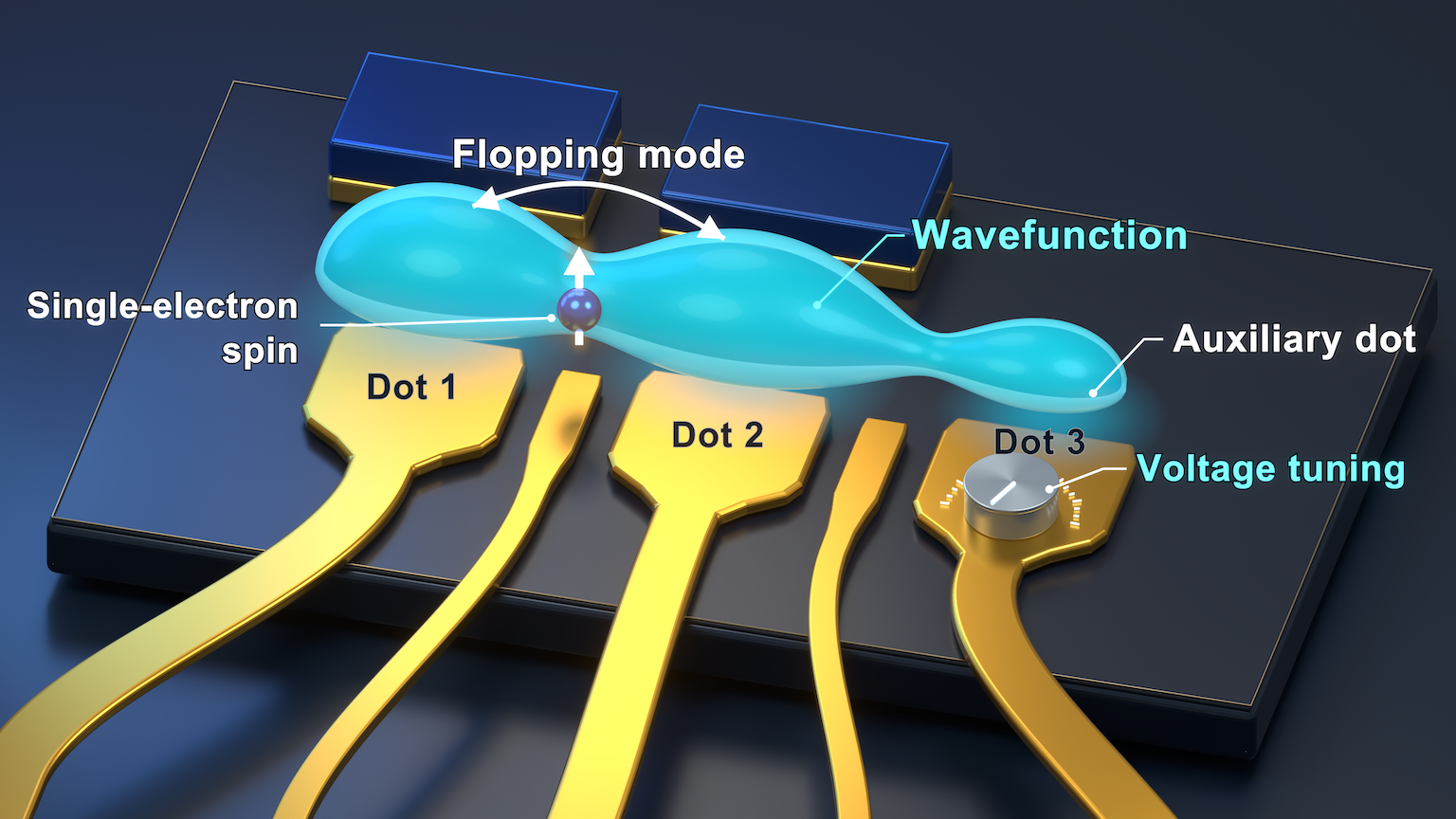

Researchers at the University of Osaka developed an “orbital band engineering” approach that adds an auxiliary quantum dot to semiconductor spin qubits. Electrically tuning the extra dot helped balance fast operation with resistance to electrical noise, two properties that normally compete. Combined with machine-learning-based frequency correction, the method enabled fast, high-fidelity qubit control and could provide a useful strategy for post-fabrication tuning and scaling of semiconductor quantum computers.
Fig. 1
Conceptual illustration of a triple-quantum-dot spin qubit with AI-based microwave-frequency feedback informed by spin readout at Dot 1.
Original content, Credit must be given to the creator., Yuta Matsumoto
University of Osaka researchers demonstrate an electrically tunable design for faster, more stable semiconductor qubits
Osaka, Japan – Quantum computers need qubits that can be controlled both quickly and reliably. Yet making semiconductor spin qubits faster often makes them more sensitive to electrical noise, creating a difficult trade–off. Researchers at the University of Osaka and their collaborators have now demonstrated a way to loosen this constraint by adding one extra quantum dot, allowing speed and noise resistance to be tuned more independently after the device has been made.
Quantum dots are tiny regions in a semiconductor that can confine individual electrons. In conventional flopping-mode spin qubits, two quantum dots are used to move an electron between locations, enabling fast electrical control of its spin. However, the same conditions that increase operating speed can also make the qubit more vulnerable to small voltage fluctuations.
The researchers added a third, auxiliary quantum dot whose energy could be adjusted electrically. By tuning this extra dot, they reshaped the electron’s orbital energy structure, a strategy they call orbital band engineering. This created a broader operating region that was less sensitive to voltage noise while preserving the strong coupling needed for fast spin control. The team achieved operating frequencies above 100 MHz, reaching 271 ± 20 MHz under another tuning condition.
They also combined the device design with machine-learning-based feedback that continuously corrected slow shifts in qubit frequency. This extended the estimated dephasing time from about 52 nanoseconds to 580 nanoseconds. Randomized benchmarking showed a 4-nanosecond gate fidelity of 99.56% with feedback, rising to 99.72% with additional pulse optimization.
“In GaAs quantum dots, magnetic noise makes fast electrical control particularly important, while electrical control also makes voltage noise relevant,” says Takafumi Fujita. “By adding an auxiliary quantum dot, we introduced an extra degree of freedom for tuning the qubit frequency and could explore operating regions that are less sensitive to electrical noise.”
The approach could provide a useful design principle for correcting device-to-device variations after manufacturing, a key challenge when scaling semiconductor quantum computers to very large numbers of qubits. The researchers expect that the concept could also be applied to silicon- and germanium-based spin qubits.
###
The article, “High-fidelity flopping-mode single-spin operation via triple-dot orbital-band engineering,” was published in npj Quantum Information at DOI: https//doi.org/10.1038/S41534-026-01400-1
About The University of Osaka
The University of Osaka was founded in 1931 as one of the seven imperial universities of Japan and is now one of Japan's leading comprehensive universities with a broad disciplinary spectrum. This strength is coupled with a singular drive for innovation that extends throughout the scientific process, from fundamental research to the creation of applied technology with positive economic impacts. Its commitment to innovation has been recognized in Japan and around the world. Now, The University of Osaka is leveraging its role as a Designated National University Corporation selected by the Ministry of Education, Culture, Sports, Science and Technology to contribute to innovation for human welfare, sustainable development of society, and social transformation.
Website: https://resou.osaka-u.ac.jp/en
Advertisement